
St Andrews, March 2025 – Besides refurbishing and distributing thousands of devices every year, ReusingIT’s Founder and Director Ross Cockburn is tireless in his evangelism for charitable tech reuse, encouraging other organisations to get on-board the reuse train to tackle digital exclusion and climate change.
One of his presentations last year has been a catalyst for an IT Repair Cafe being set up by Transition University of St Andrews [Link to: https://transitionsta.org/], a climate change and resilience organisation, with the first event taking place this month (March 2026).
Early last year, staff of Transition University of St Andrews attended a presentation by Ross at the University of St Andrews. The University is a major donor of used devices to ReusingIT. Their regular turnover of end of life computers and laptops continues to be a significant contribution to the shipments we make to support Ukraine’s Unbreakable Education initiative. The presentation included a screening of the documentary “Silent Night” [Link to: https://www.reusingit.org/silent-night-a-documentary] to share with the university and wider community what a difference their donations are making.
Sonja Potjewijd and Anya Hart Dyke, both Project Officers for Transition University of St Andrews, were in the audience.
“We were very inspired at seeing what could be done with refurbished end of life devices – upskilling people to carry out the work, saving the devices from landfill and using them to give someone else a new chance at life. It got us thinking about what we could set up in the local area in terms of refurbishing tech, given the huge impact it can have,” says Sonja.
Part of Ross’ presentation was about keeping resources circulating locally. ReusingIT ships a lot overseas, but equally Ross wants to see a lot more being done in local areas, reusing resources that are right there in the community already for the benefit of those communities. “Ross inspired us when he said he wanted to see devices fixed and used locally – this was something we could absolutely take action on,” adds Anya.
In collaboration with the Fife Communities Climate Action Network (FCCAN Fife Climate Hub), [Link to: https://fccan.org.uk/ ] Sonja and Anya set about organising an event at St Andrews Town Hall (31st January 2026) with the aim of exploring the establishment of an IT Repair Cafe in St Andrews. The event included a workshop where Ross shared his experience and expertise on how to approach tech refurbishing. It revealed a huge appetite for the concept.
Transition University of St Andrews already run a monthly repair and advice cafe for a whole range of items, from clothing and jewellery to electrical equipment and musical instruments. They also have a unique initiative of hyper-local reuse stations dotted across the university campus and in the community. “Anything that can be repaired, we tackle rather than throw away, and it’s about changing people’s mindset around repair and reuse.” A dedicated IT Repair Cafe would be a high-impact addition to this offering.
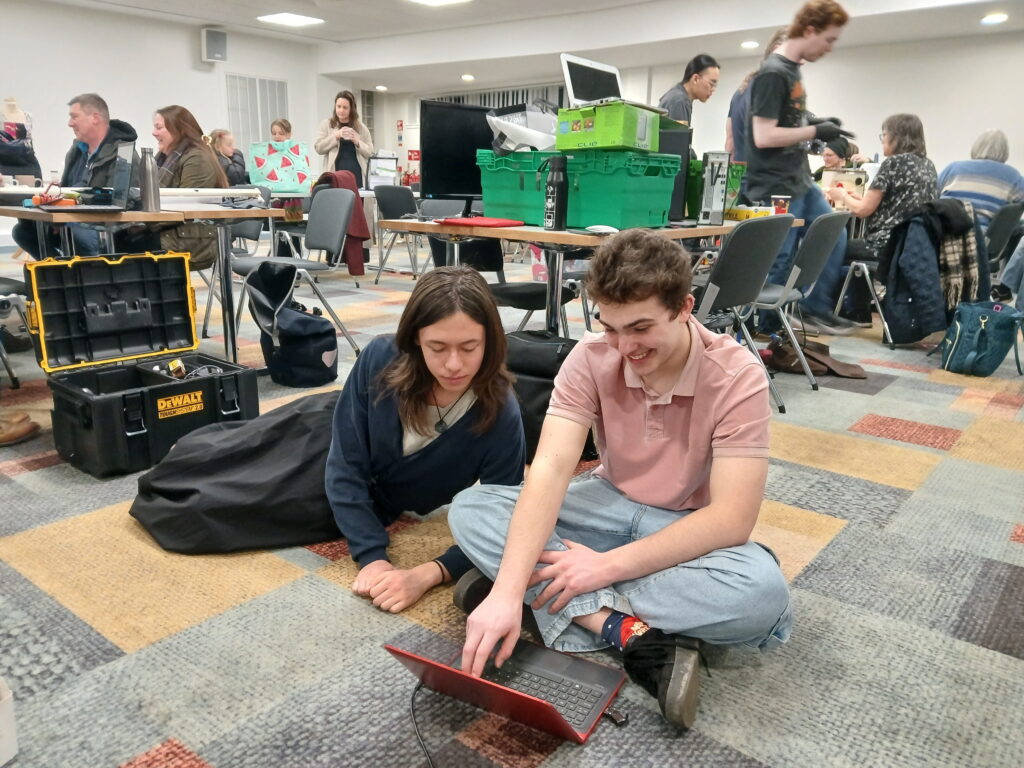
And so the first IT Repair Cafe by Transition University of St Andrews has just taken place (end March 2026). Open to anyone with a device needing to be repaired, as well as refurbishing donated devices, it was led by members of staff from the University. Besides helping people who came in, they repurposed two laptops that have now been donated to members of the community in need – the first of many.
“A repair cafe is powerful in that you are sitting opposite the person you are helping,” says Sonja. “A real community of repairers develops, and besides the satisfaction of being able to help someone, many repairers come because they want to learn from each other and share ideas. If one person can’t fix something, there is likely to be someone else in the room who can.” At the first IT Repair Cafe, a history professor bought in her laptop which wouldn’t close; a screw had become dislodged internally, all but destroying the usefulness of what was otherwise a perfectly functioning device. After some discussion among the repairers, she agreed to one of them drilling into the case to fix it – which worked perfectly! An imaginative solution, if somewhat nerve-wracking for a few minutes, but meant she left with a once-more fully functioning laptop. “A perfect example of where the mindset to tackle a repair rather than discard ended up saving the owner a lot of hassle and saving a device from landfill.”
Another effect of Ross’ catalytic presentation last year is that the Fife Climate Hub who helped organise the Town Hall event in March have set up a Circular Economy Knowledge Circle – a regular online meet to share knowledge on reuse and repair across Fife.
The positive attitude in St Andrews towards reuse and repair has taken on tech with gusto, showing that with a little inspiration and support, anyone can get on board with tackling tech waste.